In 1955, builders Howard Edmunds and Robert Puig paid $3,000 an acre for 200 acres off Memorial Drive. They didn't have enough money to build on it alone, so they brought in three investors to form the Memorial Bend Development Company. One of those investors was William Norman Floyd, the architect whose houses helped set the look of residential Houston from the 1940s through the late 1960s. Seventy-one years later, the land under those houses is most of what a buyer is paying for. The houses are also why many buyers want to be on these streets in the first place.
On the Houston side of Memorial, fall 2026 sales split in two. Homes that sold went fast, in about a week. Homes that didn't sell stayed on the market longer and longer. By November, the typical active listing in 77079 had been for sale for about a month, so the useful first question about any listing a buyer sees this winter is what it is actually being priced as.
What Edmunds, Puig and Floyd put on the ground
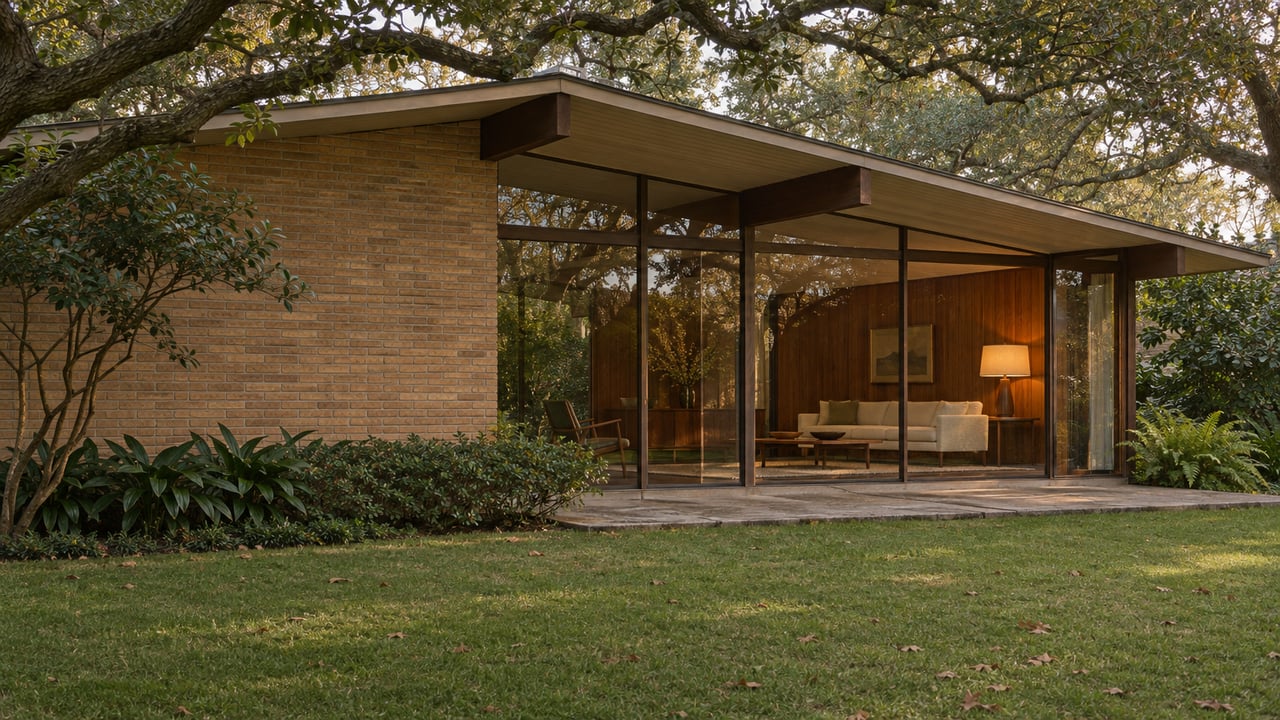
Houston Mod calls Memorial Bend home to one of the largest concentrations of 1950s modern houses in Houston. Floyd wasn't the only architect there. William R. Jenkins, Harwood Taylor, Lars Bang and Brooks & Brooks all designed houses in the neighborhood, and Jenkins and Taylor worked as draftsmen for Floyd early in their careers. Floyd designed about 50 of his roughly 500 Houston-area buildings in Memorial Bend. Monroe Construction Company built most of them, and Al Fairfield, Vernon Griffin and Allan Huvard were among the other builders.
The neighborhood went up quickly. Houston Mod's archive of period Houston Chronicle advertisements traces it from the 1954 announcement, to the first family moving in on September 9, 1956, to a third section opening on June 29, 1958. The designs were a mix. Some were traditional. Others were modern, with flat, low-pitched or butterfly roofs and clerestory windows.
Some of those houses are well documented. Houston Mod's August 2021 Mod of the Month featured 12922 Traviata Drive, a Floyd design reported to have won a 1958 American Builder award. The same page notes that 12902 Figaro Drive, another Floyd house, appeared in American Builder in August 1959. A Memorial Bend neighbor group still asks residents for original blueprints, old photographs and promotional material for its preservation records.
Memorial Bend's neighbors grew up in the same years. The Frostwood civic association represents 360 homes and was incorporated in 1960. Houston Association of Realtors 2025 neighborhood figures put the median year built at 1963 in both Memorial Bend and Frostwood.
One neighborhood, three different products
A 1963 median build year doesn't mean every house is from 1963. The same 2025 HAR figures that give Memorial Bend that median count 353 single-family properties, and HAR's neighborhood description notes that many homes there have been renovated or rebuilt.
The rebuilding has been going on for years. In February 2018, the Houston Chronicle reported at least 19 residential demolition permits in Memorial Bend in the months after Harvey. The paper described the loss of midcentury houses as a longer trend that the storm and rising land values sped up. By December 2024, a Chronicle guide to Houston's midcentury neighborhoods said large new homes had replaced many of Memorial Bend's original houses.
The middle option has examples nearby. In April 2021, the Chronicle covered the renovation of a 1965 house in Memorial Glen. Working with designer Casey Brand, the owners kept the courtyard and the midcentury character and updated the kitchen, laundry and bathrooms.
So a buyer shopping Memorial Bend is choosing among original houses, renovations and new builds under one neighborhood name. Those three products sell at very different price points. A neighborhood median blends them together, so it can't tell you which one a listing is. HAR's 2025 figures put the median sold price per square foot at $356.83 in Memorial Bend and $430.83 in Frostwood. That gap comes from a mix of house types across two neighborhoods with nearly the same median build year. It doesn't measure the value of a location. We made the same point about West University Place, where $1.8 million can buy a house or just the lot. It applies here at a different price.
The fall numbers: sold fast, unsold aging
Monthly Houston Association of Realtors data for ZIP 77079 shows the split clearly. These are single-family figures for late summer and fall 2026:
| Month, 2026 | Closed median price | Closed median days on market | Active listings | Active median days on market |
|---|---|---|---|---|
| August | $918,050 | 4 | 87 | 24 |
| September | $860,000 | 8 | 82 | 34.5 |
| October | $910,000 | 7 | 82 | 47 |
From August through October, the homes that closed in 77079 had been on the market for a median of four to eight days. Over the same months, the median listing still for sale went from 24 days old to 47. Closed sales fell from 20 in August to 13 in October. The active list barely changed, staying between 87 and 82 listings. In November, HAR counted 79 active listings in 77079 with a median of 32 days on market.
Taken together, the numbers say a buyer this fall wasn't facing one market. A well-matched house sold within a week. Another house in the same ZIP could sit for six weeks or more, and only that second group shows up in the active numbers.
Next door in 77024, prices are higher but the pattern is similar. From August through October 2026, closed median prices were $1,755,000, $3,000,000 and $2,007,500, with median days on market of 16.5, 13 and 21. Active listings fell from 93 in August to 66 in November, when the median active listing had been on the market for 50 days. With only 12 to 24 sales a month, a $1.2 million swing in the median between August and September mostly reflects which houses happened to close. It says little about a change in value.
Why the winter list is a different list
Late November begins the slowest stretch on the 77079 calendar. In January 2026, the ZIP recorded 6 single-family sales at a median of 39 days on market. In January 2024, it recorded 9 sales, also at 39 days. In most other months of the past two years, the closed median stayed in the single digits or teens. February 2026 came in at 17 sales and 19 days. The pace returned that March, with 18 sales at 6 days.
Put that next to the fall split. In 2026 the 77079 homes that sold went within about a week, and fewer sales closed each month from August to October. As of November, the median active listing had already been on the market for 32 days. A listing that has been sitting for a while might be an original priced like a renovation, a renovation priced close to new construction, or a good house that came to market in a slow month. On paper all three show the same neighborhood name and roughly the same year built.
That's why it helps to decide which of the three products you're shopping for before comparing prices. Someone who wants a Floyd-era house with its clerestory windows intact is shopping a different market than someone who sees a 1960s lot as a place to build. A renovation buyer falls somewhere between. They're paying for work already done, and they're comparing it with what that same work would cost on an original. Each buyer can look at the same listing and reach a different conclusion about its price, and in a slow month the gap between those conclusions is where negotiation happens.
Questions buyers ask about Memorial Bend
Who designed the houses in Memorial Bend? William Norman Floyd is the best-known name. He was one of the original development company's investors and designed about 50 houses there. William R. Jenkins, Harwood Taylor, Lars Bang and Brooks & Brooks also designed houses in the neighborhood. Houston Mod's Memorial Bend architecture pages collect photographs, period articles and maps.
How fast are Houston-side Memorial homes selling right now? In 77079, homes that closed from August through October 2026 had a median of four to eight days on market. Homes still listed in October had a median of 47 days, and in November that figure was 32 days across 79 active listings.
Is winter a slower time to buy in this part of Memorial? In both January 2024 and January 2026, closed sales in 77079 had a median of 39 days on market, with fewer than 10 sales each month. The pace has picked up again by March. For more on the area, see our Memorial neighborhood page.
If you're weighing an original Floyd-era house against a renovation or a lot to build on this winter, Topmark Realty Group can talk through the Memorial Bend and 77079 listings you're considering, so you know which of the three you're pricing before you make an offer. Already own one of these midcentury houses? Our home valuation page is a good starting point. Let's talk about your next move.